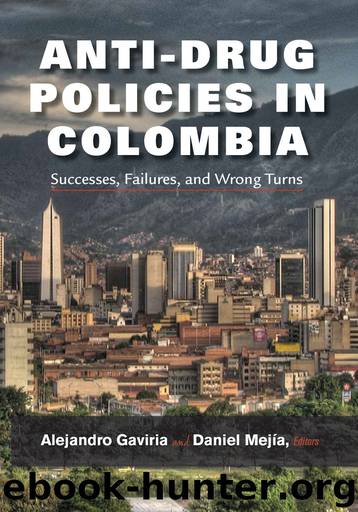
Anti-Drug Policies in Colombia by Alejandro Gaviria
Author:Alejandro Gaviria
Language: eng
Format: epub
Publisher: Vanderbilt University Press
Published: 2016-04-18T04:00:00+00:00
PART IV: LEGAL AND INSTITUTIONAL ASPECTS OF THE WAR ON DRUGS
9
The Consumer’s Right to a “Personal Dose” and the War on Drugs
A Study of the Policing of Drug Consumption in Bogotá, Colombia
Julieta Lemaitre and Mauricio Albarracín
In 1994, the Colombian Constitutional Court ruled that criminalizing the possession and use of small amounts of narcotics violated the constitutional right to the free development of personality.1 The decision, controversial from the start, gave rise to a conservative backlash that culminated in December 2009 with the constitutional reform that prohibits the possession and consumption of narcotics, without specifying the nature of the prohibition. Even before this reform, however, the police habitually arrested people for the possession and consumption of drugs. This arrest, which is transitory, usually affects homeless people and young men from the poorer classes who smoke marijuana and bazuco, a cheap by-product of cocaine, in parks and plazas.
It is well-known that the life of the law does not only rest on its enactment but its daily enforcement. Citizens may massively disobey laws with impunity, which turns them into mere “paper” laws (García 2009). Also, public officials may or may not enforce the law, or may enforce only part of it, or enforce it only in certain circumstances, or may have different opinions of how it should be enforced. Furthermore, the implementation of laws may differ from their written content and have unforeseen effects, either because of the existence of other rules or because they affect different social groups differently. The conduct of both citizens and the state as well as the unforeseen consequences of the law causes a gap between the law on the books and the law in action, a breach that has been the object of much US literature on the relation between law and society and that is now responsible for a growing Colombian literature on the same issues (Jaramillo and Alfonso 2008; García 2009; Lemaitre 2009; Rodríguez and Rodríguez 2010).
This chapter explores the breach between the right to the possession and consumption of a personal dose, established by the Constitutional Court in 1994, and daily practice. The questions we seek to answer are: How is the right to the personal dose applied? That is, does the freedom decreed by the Constitutional Court really exist? If so, how can that freedom coexist with the repression of consumption in public places, which is also ordered by law? What is happening with the constitutional reform? What meanings are given to the personal dose on the streets and in public forums? The answers to these questions are based on a study both of the norms and the political context in which decriminalization and the reaction against it took place. Once this analysis is set forth, we present a study of the daily practice of enforcement by the Bogotá police, the conclusion of which is that in certain circumstances, the police have not stopped repressing the possession and consumption of the personal dose, regardless of the right to the free development of one’s personality.
Download
This site does not store any files on its server. We only index and link to content provided by other sites. Please contact the content providers to delete copyright contents if any and email us, we'll remove relevant links or contents immediately.
Unwinding Anxiety by Judson Brewer(73044)
The Art of Coaching by Elena Aguilar(53249)
The Fast Metabolism Diet Cookbook by Haylie Pomroy(21143)
Rewire Your Anxious Brain by Catherine M. Pittman(18654)
Healthy Aging For Dummies by Brent Agin & Sharon Perkins RN(17045)
Talking to Strangers by Malcolm Gladwell(13370)
The Art of Thinking Clearly by Rolf Dobelli(10489)
Mindhunter: Inside the FBI's Elite Serial Crime Unit by John E. Douglas & Mark Olshaker(9343)
Crazy Rich Asians by Kevin Kwan(9292)
The Compound Effect by Darren Hardy(8966)
Tools of Titans by Timothy Ferriss(8395)
Periodization Training for Sports by Tudor Bompa(8272)
Becoming Supernatural by Dr. Joe Dispenza(8217)
Wonder by R. J. Palacio(8110)
Crystal Healing for Women by Mariah K. Lyons(7931)
Bodyweight Strength Training by Jay Cardiello(7917)
Change Your Questions, Change Your Life by Marilee Adams(7781)
Therapeutic Modalities for Musculoskeletal Injuries, 4E by Craig R. Denegar & Ethan Saliba & Susan Saliba(7722)
Nudge - Improving Decisions about Health, Wealth, and Happiness by Thaler Sunstein(7706)
